 What's My Set
Tabata Explained: The 20/10 Protocol
Tabata is a form of high-intensity interval training with a strict recipe: 20 seconds of all-out work, 10 seconds of rest, repeated 8 times (exactly 4 minutes). It's named after Dr. Izumi Tabata, whose 1990s research with Olympic speed skaters found the protocol improved both aerobic and anaerobic capacity remarkably fast.
The rules that make it Tabata
- 20 seconds of work at genuinely maximum effort. The intensity is the point.
- 10 seconds of rest. Barely enough to reset, which is also the point.
- 8 rounds, no more, no less, for the classic protocol (though apps let you customize).
Good Tabata exercises
Pick movements you can push to near-max safely when exhausted: burpees, air squats, mountain climbers, kettlebell swings, bike sprints, rowing. One exercise for all 8 rounds is classic; alternating two (e.g., squats/push-ups) is a popular variation.
The timing problem: 10 seconds is not enough time to look at a clock
With intervals this short, glancing at a stopwatch mid-burpee ruins the effort, and by round five your brain can't be trusted to count to eight anyway. A proper Tabata timer has to tell you what phase you're in without being looked at.
Running Tabata with What's My Set
What's My Set includes a Tabata timer (part of the Pro upgrade) built around exactly that:
- Choose Tabata and confirm your work/rest/round settings (the classic 20/10 × 8, or your own variation).
- Hit start. The app runs the rounds automatically. No tapping between phases.
- Hear and see the difference. Work and rest phases get distinct audio cues and distinct visuals, so you always know which one you're in, even face-down between rounds. If you use Differentiate Without Color, phases are distinguished by more than hue.
- Watch the round count, not the clock. Time remaining in the current phase and the round number are shown in large, easy-to-read type.
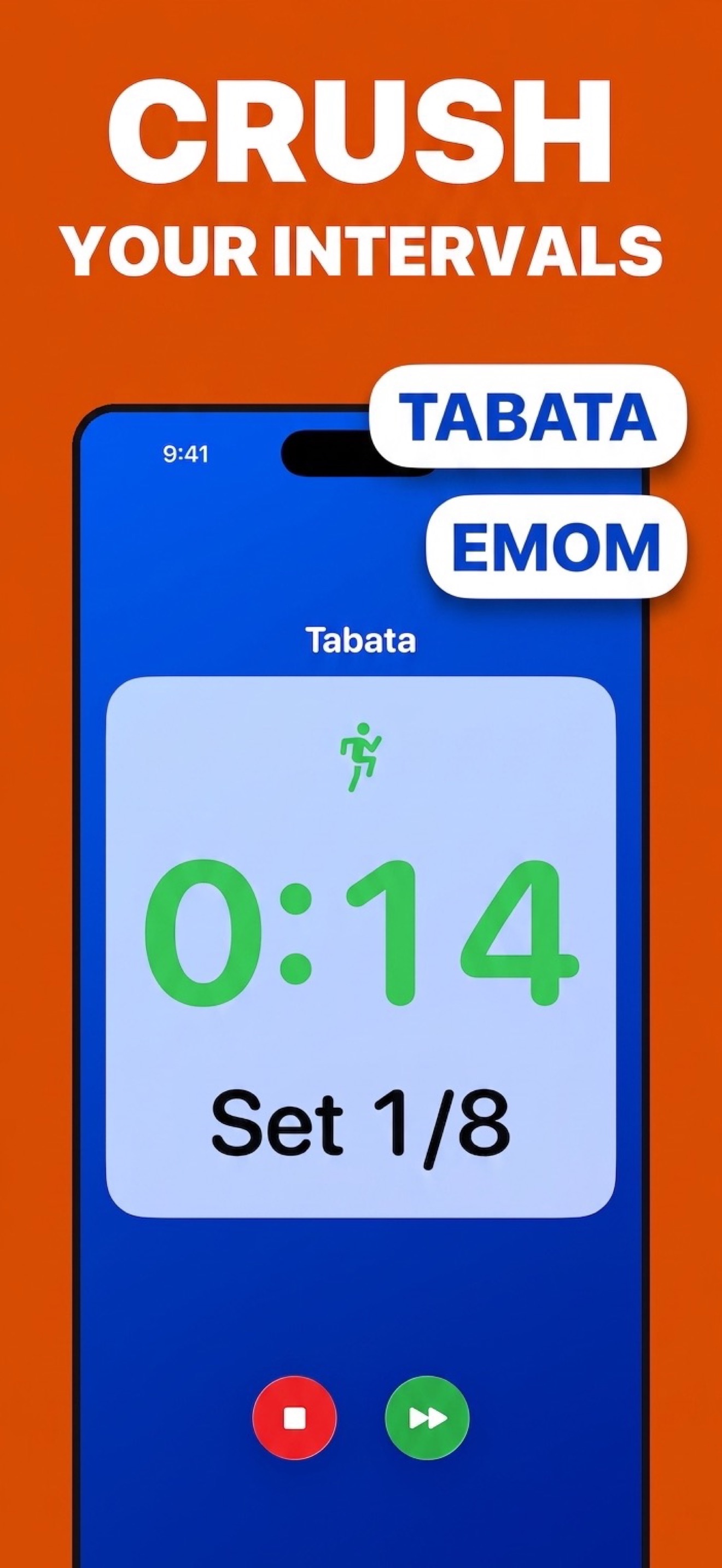
It works on iPhone, iPad, and standalone on Apple Watch, so a garage-gym Tabata needs nothing but your wrist. Prefer minute-based rounds instead? See what an EMOM workout is.
Four minutes. Zero clock-watching.
Download What's My Set free for the set counter and rest timer; the Tabata timer with automatic rounds and unmistakable work/rest cues is part of the Pro upgrade.
 Free set counting · Tabata timer with Pro